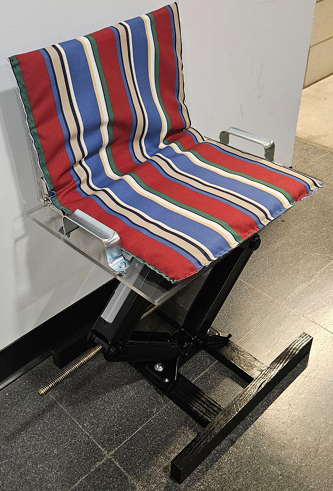
The Scissor Seat
A drill-driven lift seat that lets one caregiver raise a fallen adult off the floor
- Context
- Design Thinking and Communication, Northwestern — project partner Shirley Ryan AbilityLab (Katy Morrison, Administrative Director of Day Rehab)
- Role
- Four-person team — design, analysis, fabrication
- Timeline
- June 2025
Problem
More than 25% of people over 65 fall each year. Most of those falls cause no injury, but many leave the person unable to get back up without multiple helpers or emergency services.
The partner’s father, Ed, has hemiparesis following a stroke twenty years ago and falls several times a year; recovering by leaning on furniture takes him about 30 minutes. His wife is healthy and fit but cannot lift him on her own. Existing products — the Raizer 2 lifting chair, the AX08 electric chair lift, the ELK lifting cushion — work, but are expensive, electrically powered, or both, which limits where they can be used and who can afford them.
Requirements
- Under 6 in tall collapsed
- At least 18 in at full extension
- 200 lb load capacity
- Portable throughout a house
- Storable in a standard closet
- Operable by someone of ordinary strength
Photo — the finished Scissor Seat
Design
Four subsystems, each carrying its own spec and rationale.
Scissor Jack
A screw jack converts input torque into vertical travel with mechanical advantage set by thread pitch and member length. With a 6 in wrench arm this jack gives roughly a 1:30 input-to-output ratio, so a user capable of 50 lb of input can lift up to 1500 lb; driven by a drill, output reaches the jack’s 5000 lb rating.
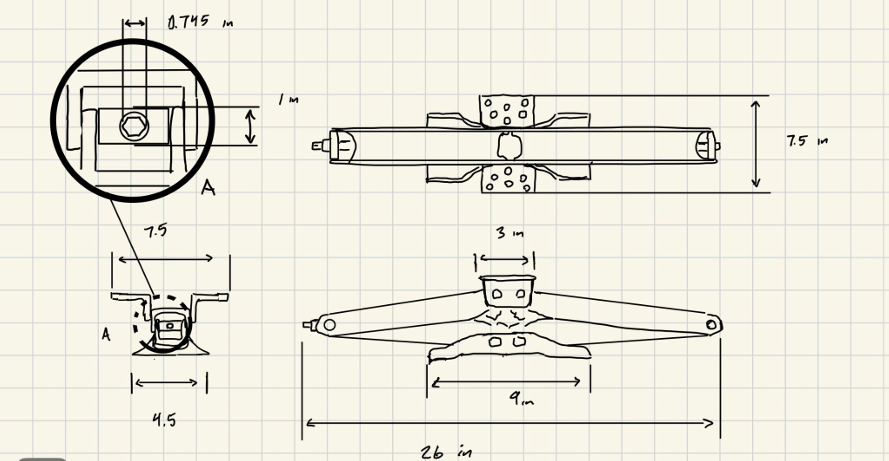
Isometric drawing — scissor jack
- Collapsed dimensions: 26 × 7 × 4 in
- 12 in members, 4–24 in lift range
- Steel alloy, cambered base
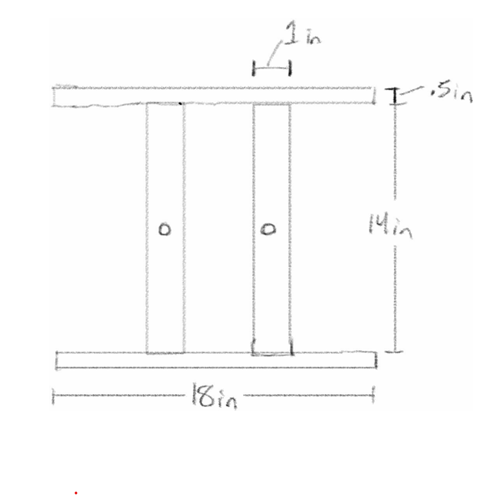
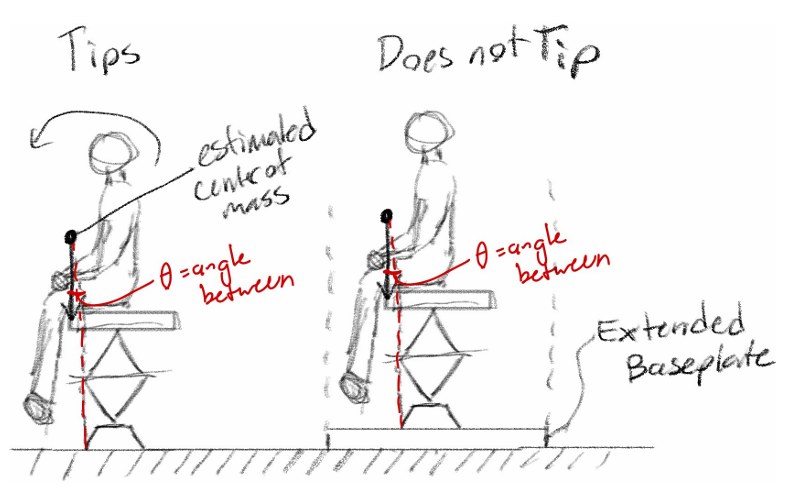
Extended Baseplate
A pinewood frame bolted to the jack base, 18 × 15 in, spray painted black.
As the seat rises, the center of mass rises with it, and any horizontal offset applies a larger tipping moment (M = W · h · sinθ). Widening the base of support raises the tipping threshold. Built as a frame rather than a solid panel to keep the same footprint at lower weight. Pinewood for cost, low density, and workability.
Foldable Padded Seat
Two ⅜ in acrylic plates — a 14 × 18 in base sized against typical office chair dimensions, and a 15 × 10 in backrest sized to sit between the handles without overhanging — joined by auto-locking hinges. Pull the backrest up and it locks at 90°; press the hinge spring to fold it flat. Acrylic for stiffness and cost relative to metal. Both plates padded.
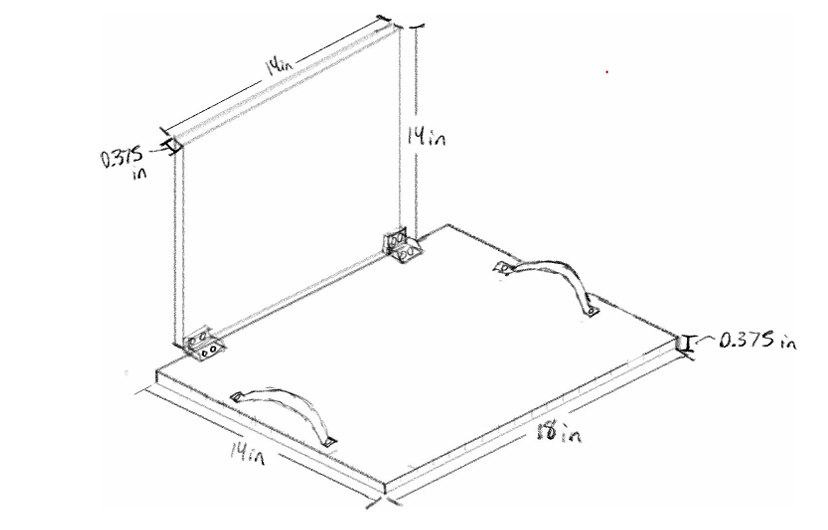
Isometric drawing — foldable padded seat
Handles
Added after user testing found the device awkward to carry with nothing to grip. Positioned so the seat still folds.
Operation
The person who fell sits on the seat; the caregiver drives the jack screw with a drill at max torque until the seat reaches standing height; the person stands, and the seat folds and stows.
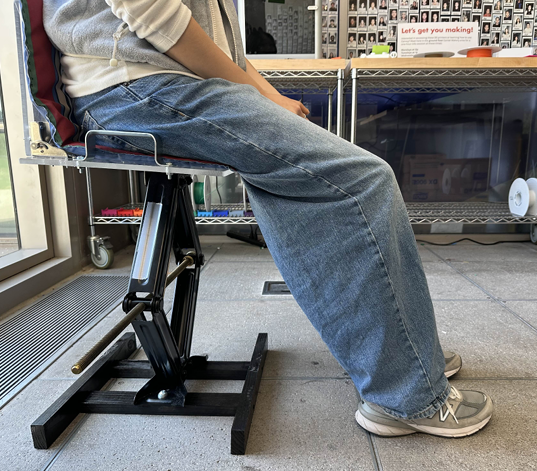
Photo — the seat raised to standing height, in use
Limitations and Next Steps
The finished device weighs 23 lb — under the 25 lb the caregiver can carry, but not comfortably. A lighter jack that still carries a person’s weight, and lighter materials elsewhere, would be the highest-value change.