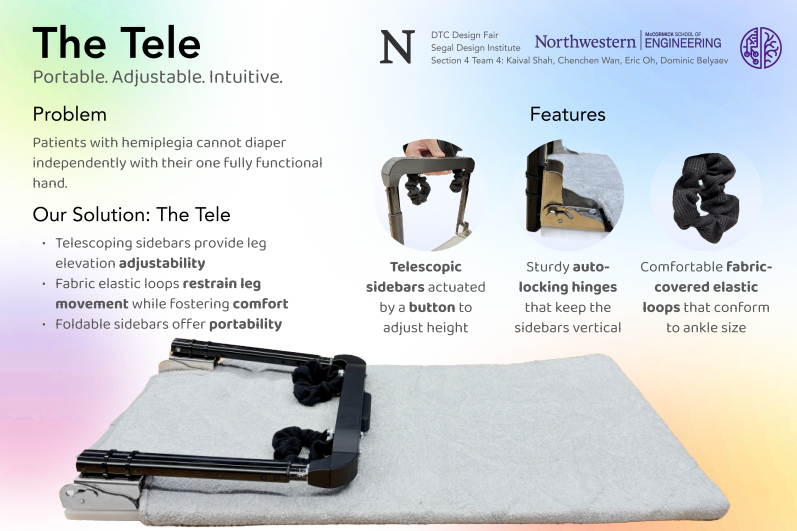
The Tele
A one-handed baby diapering assistor for parents with hemiplegia
- Context
- Design Thinking and Communication, Northwestern — project partner Brianne Trainor, PT, Ascension Alexian Brothers Rehabilitation Hospital
- Role
- Four-person team — design, prototyping, user testing
- Timeline
- December 2024
Problem
Hemiplegia — paralysis on one side of the body, caused by stroke, aneurysm, spinal injury, or cerebral palsy — leaves a parent with one fully functional arm.
Diapering is inherently a two-handed task: one hand holds the infant’s legs up while the other cleans, and the legs must stay lifted while the new diaper is slid underneath. Observing a two-handed diapering made the constraint concrete — the two tasks simply cannot be done concurrently with one hand.
Existing options don’t close the gap. Changing pads secure the baby and protect the surface but don’t move the legs. Tab-style diapers are easier to fasten but still have to be slid underneath. Rehab exoskeletons restore some arm function but are tethered to a large power source and are prohibitively expensive.
Requirements
- Fully operable with one hand — setup, use, and takedown
- Rear access for cleaning
- Portable, since babies need changing 5–12 times a day and it can happen anywhere
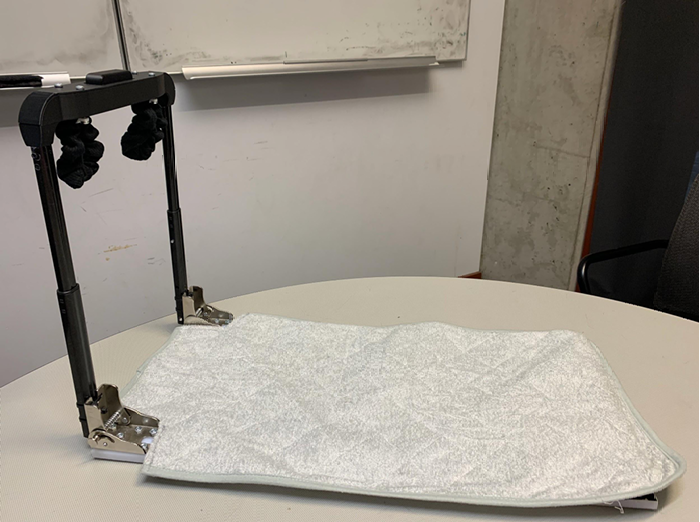
Photo — The Tele prototype, handle extended
Design
Built bottom up, each component with its own spec and rationale.
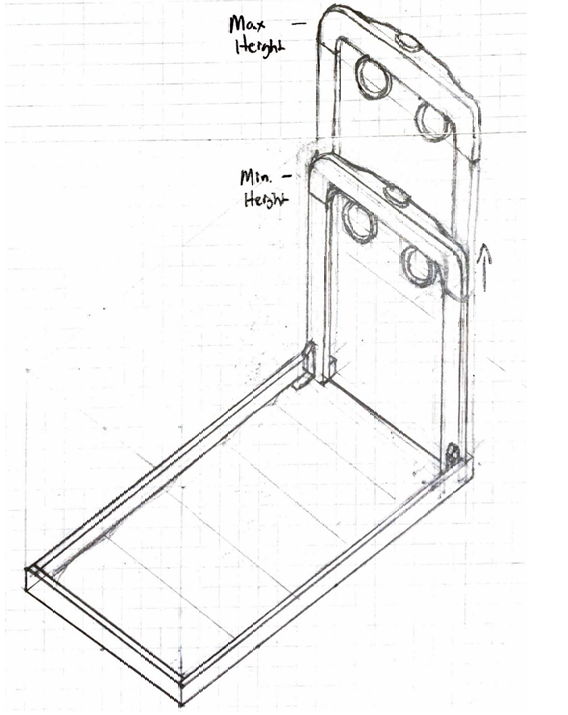
Isometric sketch — full assembly
Base
12 × 24 × ⅜ in high-density polyethylene, 4000 psi tensile strength, curved edges, velcro along the perimeter. Sized for infants 6 months to 1 year: at 25.5–29.9 in tall with an average 11.8 in inner leg length, a baby with legs bent occupies about 24 in.
The first choice was PVC, which was rejected on materials grounds — PVC contains phthalates, which cling to dust when emitted and can exceed the 4.8 mg/kg no-adverse-effects threshold for low body weight infants. HDPE gives the same rigidity and cleanability without that risk. The ⅜ in thickness keeps it rigid without adding weight or cost.
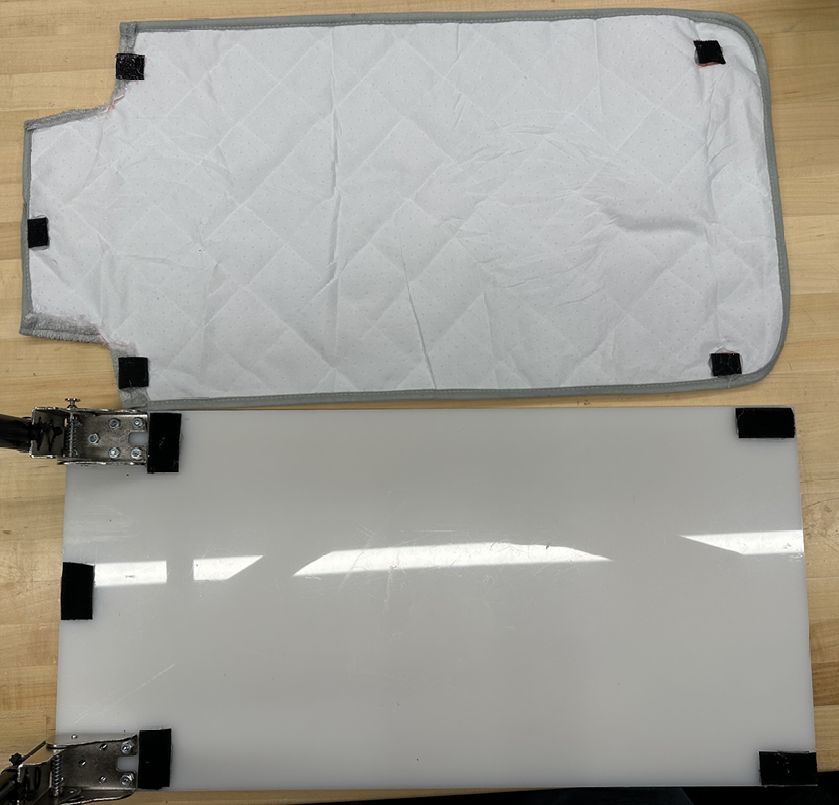
Photo — perimeter velcro attachment, pad and base
Changing Pad
12 × 24 in, 70% polyester / 30% bamboo-derived rayon, soft, waterproof, machine washable, attached by five velcro edges so it can be stripped off and washed.
Hinges
Two locking hinges connect the sidebars to the base and hold them vertical in use; they fold flat into the base for transport.
Telescoping Sidebars and Handle
Luggage-style telescoping sidebars with a locking-pin mechanism and a single actuation point on the handle, so height adjusts and locks one-handed. The adjustment range accommodates larger infants. The handle was 3D printed for the prototype.
Fabric-Covered Elastic Loops
Two loops hang from the horizontal handle. The elasticity does two jobs: it lets the legs slide in easily before changing, and it gives the infant enough freedom of movement to stay comfortable while elevated. Raising the loops lifts and separates the legs, opening rear access between the sidebars.
Next Iteration
- Fold the base with lightweight non-locking hinges for portability.
- Move to thinner HDPE to cut weight while keeping durability.
- Injection mold the handle rather than 3D printing it for strength and repeatability.